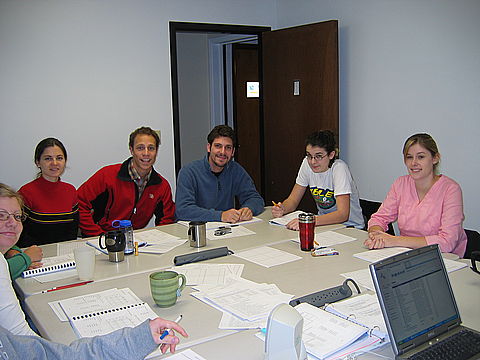
After an excellent Christmas break and an extra week off school due to bad weather I was ready to get going again. I arrived back in Missouri for my second semester of Language School only to find the campus and the little valley it sits in completely covered in ice. The power was out that night so I had to get situated in the dark by the light of my cell phone. It was only the next morning that I was able to see what exactly was going on. It was beautiful for sure but trees were splitting and dropping branches all over the place because of the weight of the ice. Everything was brittle and heavy. Walking around was quite the chore but it made life in a powerless world exciting. The power came on and off for the next few days so we came up with a lot of interesting ways to entertain ourselves in our little winter wonder land.
But alas…school is in full swing once again. This week we are working on phonetics once again, which, simply put, is the study of the sounds humans make in their articulation of language. Sounds simple, right? Well, it’s not quite that simple. You see as English speakers we only use a small percentage of the sounds, pops, clicks, and intonation used throughout the world. Take for example the simple American vowel “a” as in “can.” Phonetically it is called a diagraph and looks something like this “æ.” It can take on all sorts of modifications. For example, it can be lengthened which simply means is it held out or it can be repeated. It can be nasalized or laryngealized, which sounds similar to the way we talk when we are tired. Normally it is produced with and open or smiling face but it can be rounded and produced with the lips puckered instead. It can be glided giving it a different vowel quality altogether. It can be breathy and it can even be voiceless! A number of these modifications can be combined and on top of it all one can say this vowel in a myriad of tones! So let’s just say I’m really glad I’m taking phonetics, lest I sound like some psycho to the poor natives.
One of our newest sounds is a voiceless “L” fricative! Oh, what a joy. It makes me sound just like I have a lisp. It’s the sound many young children use in place of an “s,” and to us English speakers it IS a lisp. For those of you who have watched Ice Age, it is precisely the lisp/sound that Sid the sloth makes when he talks! Never would have guesses that I’d be learning to talk with a lisp! That reminds me once again of why I am here. Pray with me that I would glean as much possible from this training even if it means talking with a lisp so that I might be more effective in reaching those who have never had a chance to hear what you and I live by- the grace of God!
Leave a Reply
You must be logged in to post a comment.