Opening Discussion:
What pictures comes to mind when I talk about Duty of Care?
- Defined Biblically?
- Who?
- What’s the scope?
- What are the methods?
- How does this apply to caring for an individual vs the organization?
Duty of Care – Defined Biblically
1 Peter 5:1-4 And now, a word to you who are elders in the churches. I, too, am an elder and a witness to the sufferings of Christ. And I, too, will share in his glory when he is revealed to the whole world. As a fellow elder, I appeal to you:
- Care for the flock that God has entrusted to you. Watch over it willingly, not grudgingly—not for what you will get out of it, but because you are eager to serve God.
- Don’t lord it over the people assigned to your care, but lead them by your own good example.
And when the Great Shepherd appears, you will receive a crown of never-ending glory and honor.
Peter describes 2 aspects of leading that cannot be separated. Caring AND leading!
- Care for the flock that God has entrusted to you.
This is the word used for “Shepherd.” Peter says, “Shepherd the flock that God has entrusted to you.
Interesting how he describes the care of the shepherd. He says that we are to care/shepherd by “Watching over it willingly, not for what you will get out of it, but because you are eager to serve God.
- Leadership is not a platform to pursue our own agendas. We don’t become leaders for what we can get out of it.
- Bill’s “encouragement” when we started e2.. If you wanted a job where people will like you and where you will make lots of friends, this is not it. We have people across the field who still don’t like us because of the recommendations we had to make during e2.
- Leadership is lonely… lose your friends… Why is that? In all my years in various leadership position I have not experienced this… until these past 6 months.
- (also good to remember that when a leader makes a decision we don’t like. They probably aren’t making that decision because they are hoping it will enhance their position.)
- We are not leading for what we can get out of it, we are leading to serve God, and to watch over/shepherd those under our care. What does Peter mean when he says “watching over”?
- The Greek term behind “watch over” refers to active oversight, not mere observation. It implies:
- Paying close attention to the spiritual condition of the community
- Guarding against threats—false teaching, division, discouragement
- Guiding the flock toward maturity and faithfulness
- The Greek term behind “watch over” refers to active oversight, not mere observation. It implies:
For Peter’s audience, “watch over” meant vigilant, compassionate leadership in a time when the church’s survival depended on faithful shepherds.
It is the work of a shepherd whose eyes are always on the sheep, whose heart is for their good, and whose leadership reflects the Chief Shepherd (v. 4).
Shepherds lead by caring
In the ancient world, a shepherd didn’t switch hats between “comforting” and “commanding.”
He led by:
- Knowing the sheep
- Walking ahead of them
- Protecting them from danger
- Guiding them to safe pasture
Leadership was expressed through care, and care required leadership.
- Don’t lord it over the people assigned to your care, but lead them by your own good example.
Peter acknowledges there is a danger for leaders to “lord over” those they lead. But, he also doesn’t shirk the responsibility to lead!
Oversight protects, not controls
Oversight is not authoritarian.
Peter explicitly rejects:
- Leading “under compulsion”
- Leading “for gain”
- Leading “domineering over those in your charge”
Oversight is protective guidance, not positional power.
As leaders we have been talking a lot about this dichotomy. Leading AND caring. It was interesting when I listened through Dan Rabe’s challenge to the SAM field, this topic was at the forefront also. In this passage, Peter is clearly calling us as leaders to both Care AND lead!
Care without direction leaves people vulnerable
Barnes and other commentaries note that a flock without guidance is exposed to wolves, cliffs, and starvation. So “care” that refuses to lead is actually neglect.
On the other hand, direction without tenderness distorts Christ’s model
Jesus leads His sheep, but He also:
- Knows them by name
- Carries the wounded
- Seeks the lost
- Lays down His life
Christlike leadership is always authority expressed through sacrifice.
We can’t lead effectively without caring for our personnel
We also can’t care for our personnel if we aren’t leading well.
Peter did not see a dichotomy between these 2 things at all. He saw them as two sides of one calling, and he intentionally binds them together so they can’t be separated.
The modern dichotomy between “pastoral care” and “leadership” is foreign to Peter.
Shepherding is willing, joyful responsibility
How does this dichotomy play out in other life scenarios:
Family / marriage
How does this work in a family?
Parenting: Parents have a duty of care for their children. This includes lovingly leading them by shepherding their hearts (Ted Tripp)
If a parent made no decisions and just let the kids do what they want, what kind of family environment would that produce? Or when parents abdicate the decisions to the kids, what kind of family does that produce?
a flock without guidance is exposed to wolves, cliffs, and starvation. So “care” that refuses to lead is actually neglect. In child protection realm, parents can be prosecuted for neglect
How about in a marriage:
For those of you who were here on Sunday, I shared my story about the measuring spoons.
When there is a difference of opinion in how a decision should be made, what produces unity? Does unity come when I agree with my wife about how to put the dishes away? That does produce some unity… but what happens in the long term if the wife continues to dominate and the husband feels he has no authority? Is that unity?
So, when there is a difference of opinion when it comes to decision making… and a decision needs to be made… and the parties don’t agree, unity is not the decision… unity is how we respond to the decision… are we still seeking God’s glory and His righteousness? Sometimes as a husband, that means I consider my wife, and I choose to listen to her and prefer her over my own desire. But, there are also times, as the head of my house that I make the decision, and even if she disagrees, unity comes when she is willing to give up her desire, and submit… in pursuit of God’s glory.
And when we are all focused on that, then our righteousness / His righteousness will shine like the dawn! And that’s where unity comes from! (Is 62:1-2)
Can you still have unity if you don’t agree on a decision?
In a marriage, the husband has the responsibility to make the decision. Husbands are also commanded to love your wife, as Christ loved the church. That should result in listen to and understand his wife, but when there are differences, it is the husbands Biblical responsibility as the head of the house to LEAD, which means making the decision.
In 1 Cor 13 Love is presented not only as the fruit of leadership, but as its fuel—rooted in receiving God’s love and expressed in leadership that endures because “Christ’s love compels us” This should be true in our marriage, but also in our leadership.
Gifting, sacrifice, competence, and even faithfulness over time are rendered empty if they are not “bathed fully in love.” While at the same time, the leader is the one who has the responsibility to make a decision. And just like in a marriage, unity comes in submission to the authority God has established.
A husband who rules with an iron fist and does not consider his wife does not bring glory to God. The same is true with leaders. But, the responsibility of decision making still rests with the leaders, and it’s the responsibility of the wife to submit as well as followers…
- Part of the leader’s duty of care is to make decisions and set direction. Yes, to do that in fellowship and not with a heavy hand. But, it is clear from 1 Peter 5:3 the leaders responsibility is to LEAD
Care without direction leaves people vulnerable. “Care” that refuses to lead is actually neglect.
We can’t lead effectively without caring for our personnel
We also can’t care for our personnel if we aren’t leading well.
I want to give one more analogy on this topic before we move on.
Sports team
I have always been a runner. I started running track in Jr High. I was a middle / long distance guy. But I never really liked running in circles on the track. So, I really enjoyed cross-country season. But, In my 4 years of high school, I had 3 different coaches.
These coaches set the tone for the team. Elkins and Seigel were excellent coaches. As they worked with us continually evaluated our progress, helped strategize with us how to improve. Inspired courage in us, as they marked the runners on the opposing team that we need to beat in order to succeed as a team. They constantly helped us to make difficult adjustments so we could improve.
We worked together toward the common goal. Stronger members encouraging and running alongside weaker members. In Cross Country, the collective total of your finishing positions is what makes up your team score. If I took 1st place, and the rest of my team was in the 50s, we would lose as a team. Coach helped us learn to work together. Every person I could beat was one less point for the team. We were not just running for ourselves, we were running for the collaborative score of the whole team. And if you could catch up to a team mate, and run together, it helped you both to work harder together.
But, they were also very caring in how they led. They were very personable guy. They got to know us as individuals and had such a way to making us feel cared for. Seigel was a believer, and even encouraged those of us who were believers to remember who we were running for.
Then, my senior year, we got a new coach. We could all tell, this guy was really only in it for the job and the extra money. He didn’t really care about us. He wasn’t even very competent as a coach. He didn’t help us work together as a team. By the end of the season he had run me so hard that, instead of “peaking” for the State race, I was exhausted and had the worst race of my season. As a team we did terrible that year.
So, what made the difference in these coaches?
Duty of care for the individual… but also for the whole team.
This is another dynamic of our responsibility and duty of care as leaders.
- We have a duty to care for each individual. This does include continual evaluation of progress, strategy, people‑group needs, and the courage to make difficult adjustments
- But, as leaders of ntmpng we also have a duty of care for the team, team NTMPNG to shepherd the team toward working well together, considering other team mates, coming along side, encouraging them, running beside them, and all of us working together toward the common goal… Glorifying God as individuals, and as a team, seeing thriving churches planted. We will never have a healthy team as long as each individual is only concerned for their own individual score.
Duty of Care: Who
Improving our Serve pages 16-18 – The people part of leadership
- Two factors he says are critical in caring/guiding:
- Influence: leaders have a moral obligation to prioritize people; healthy relationships enable positive, lasting engagement; influence is “the hidden power behind leadership” (Spiritual Influence). (Like my coaches, Elkins and Seigel, we were happy to work our tails off for them because of their
- Trust: must be cultivated; keeping commitments, repairing when missed; trust fosters collaboration and is central to relationships (Leadership Challenge).
- The people we came to reach
If we are not thinking about the best interest of those we have come to reach, it’s possible there is no one else who is thinking of their interests.
Your unique role as Field Leaders gives you an opportunity and responsibility toward the unreached of the host country that is shared by few others
We should be keeping this in front of our people. These people must be heavy on our hearts If we falter in this, consider the implications
“Christ loved the Church and gave Himself for it.” We, too, should love the Church and, in a sense, should give ourselves for it. We should give ourselves in loving, glad service –sacrificially and devotedly — in order that the Church on earth might progress and prosper and triumph.” William McDonald
This is easy to apply when we are talking about church planting in the bush. But how does this apply on our centers? What does thinking of their interests mean?
Just yesterday I spoke with someone who gave me this argument when I challenged them with our mandate to train and develop PNGians (well, if I train a PNGian to do my job, then what will I do? This job is why I am here.)
As leaders, part of our duty of care is looking out for the interests of those we came to reach.
- The people who work with us on this team
Our commitment to consider the interest of those who work together with us
People are our greatest asset
The world is going to be reached by people… this is God’s plan. He could have done it so much better himself… but he chose to use us… the complexity, the faults, the failures… to pursue his purpose…
You do not have the luxury to choose who you lead.. Who’s best interest you are looking out for… even at the expense of efficient use of your time. (I can speak from experience, this is true) Keep this in mind as you consider one another.
(Matt. 9:35-38). We have the special privilege of working with those that the Lord of the harvest has “thrust” our way. His harvest, His laborers….our privilege to serve them.
Max De Pree says that organizations like ours should make it their business to be crazy about the people they serve. “Somebody has to be crazy about you.”
When someone takes a special interest in you… it’s empowering
- The people who send, support and care for us
What is in their best interest?
Communication
When problems come up… to draw them in to be part of the solution
Equipping them to better care for their people
- The people who are already a part of God’s work where we are
As part of the church, we don’t skip over the local church
What is God already doing here?
We have a responsibility to people who are already a part of what God is doing in PNG
- Local authorities and laws
What are the local, legal things that relate to what we are doing
Compliance with employment laws
Procedures for visas and work permits
Citizen training
Concerns for health and spreading disease (Health department visitors a couple months ago, asking to vaccinate all our kids for polio)
Grant funding and anti terrorism laws
(This is all part of our duty of care as leaders)
- Your family
The importance of loving and leading your family
God has entrusted our family to us
How can we look at to the best interest of our family, while drawing them in to what we are doing.. Not family or ministry… not sacrificing your family for ministry, but learning to sacrifice as a family
God wants to use as a family
The benefits of keeping them on your team and engaging them with you in ministry cannot be overstated.
Duty of Care – Scope of Care – Chapter 4 – Improving our Serve
- Spiritual health
- Biblically anchored –
- Have a growing commitment to God’s Word as their absolute authority for all aspects of life.
Keep – Guard – Entrust
What you heard from me, keep as the pattern of sound teaching,
with faith and love in Christ Jesus.
Guard the good deposit that was entrusted to you–guard it
with the help of the Holy Spirit who lives in us. 2 Timothy 1:13-14
And the things you have heard me say in the presence of many witnesses
entrust to reliable men who will also be qualified to teach others. 2 Timothy 2:2
This is part of the scope of our Duty of Care as leaders
- Healthy families / Singles
Families serving together
One of the greatest strengths of organizations like ours is that families come to work as families.
- Families live out their message and ministry as families.
- Families have the wonderful opportunity to engage in church planting ministries as families to other families.
Families are not a threat to the ministry; ministry is not a threat to families.
De Pree talks about the incredible resource that organizations like our have in our families; how they are key to all of us reaching our potential. (Leading without power)
- Mental Health / Extended Care
- Critical Incident Care (When is the last time we did a training? (2023) Who has been trained?)
- Extended Care – Extended Care refers to situations when members face difficulties which cannot be resolved on the field and need the extended care of a home church fellowship, sending caregivers, or mental health caregivers.
- Emotional and Mental Health – Field leaders should always seek help for situations that they determine to be beyond normal care and “normal” critical incident care.
- Healthy Teams
- Team building
- Providing guidance and help during team formation
- Equipping in resolving conflict
- Mediation and conflict management
- Educational Needs
GMA Statement Re: Education of Children
All Sending and Field Entities will have defined strategies and procedures which are appropriate within their contexts to address the following:
3. Assistance to missionaries in providing adequate education for their children.
Recommended Educational Policies for Fields
Strategic Plan for Children’s Education
Parents will develop a strategic plan for the education of their children.
- Child Protection
- Field leaders should lead the field in issues of awareness of dangers and in creativity to find safe environments for children.
- The best safety for children, even in places of risk, is parents who understand risk, who take steps to see that their children are in their protective care, even when this care is delegated by the parent to another.
“Child Safety for Global Partner Fields” should be regularly reviewed by field leaders.
Some key areas for your attention are:
- Definitions of Abuse (Sexual, Emotional, Physical, Neglect)
- Risk Factors (Isolation, Accountability, Power and Control)
- First Response Procedures and Contact Information for Follow Through
- Finances
- Security
- the primary roles of security personnel are assessing risk, finding solutions for crisis prevention, reporting, research, etc. In the event of a crisis, field security personnel must be prepared to handle all first response requirements
- Regular risk assessments are required for each field and will be made available to sending partners.
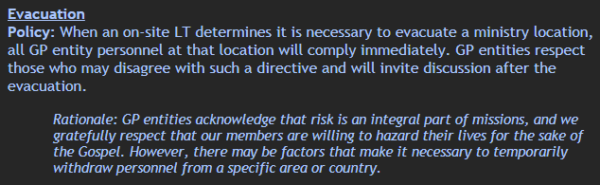
- In the broader sphere of the leadership that Global Partners provides for its members, our attention to evaluating and managing risk is part of shepherding care. Shepherding leadership in a time of crisis will mean gentle care, good communication, and watchful attention to God’s leading.
NTMPNG Field Security Manual
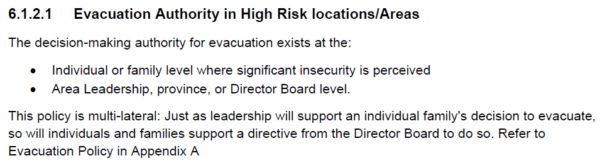
Global Partner Security Operations Policy
From <https://teams.microsoft.com/v2/>
Duty of Care – Shepherding of Caring Members
Peter weaves these together in his exhortation to leaders, and yet in our culture today it seems that we are trying to separate these 2 things. Almost as if it’s not possible to do both. In fact, this has become the debate around whether member care should be separate from leadership or not. Member care does the caring, and leadership does the leading. But, Peter very clearly gives us the mandate as leaders to do both!
Peter’s contrast—“not under compulsion… not for gain… not domineering”—shows that the heart posture is what unites care and leadership. A willing, eager, humble shepherd naturally blends both.
- Blended Care (Page 72 Improving Your Serve)
From “Leadership Definition” (Chapter One)
Blended leadership is shepherding which both nourishes and gives direction. Leaders nourish by care giving and by encouraging members in the pursuit of their God-given calling, but they also provide direction and accountability in the accomplishment of our ministry objectives.
… not overly focused on nourishing, consumed with everyone feeling happy and attended to, neglecting our ministry purposes, fearful of holding high expectations and real accountability.
… not obsessed with goal-accomplishment, neglecting to watch out for people’s spiritual health in the midst of their ministries.
When a false dichotomy between shepherding and leading creeps into our function, we have little recourse but to appoint a full squad of member care personnel and relegate the role of leaders to management. This dichotomy is not found in Scripture.
Normal Care
In that leadership is serving, essentially everything that leaders do is aimed in some way toward the care of people. Caring for members is demonstrated in the arduous work of providing careful orientation, suitable CLA programs, consultant visits, securing suitable environments for ministry, opening doors of relationships with the host country, discipling and the ministry of the Word, equipping for ministry challenges, and even the provision of reliable access to finances. All of these things are part of normal care. Spiritual concern for members is not viewed as separate from these evidences of care, but it is blended as a part of them. (refer to the above list of Scope of Duty of Care)
GMA Statement Re: Care for Members
All Sending and Field Entities will have defined strategies and procedures which are appropriate within their contexts to address the following:
2. Responsibility for the care of their members and children in fellowship with their local churches.
- Member Care Trends
- There has never been a time in missions history when the care and needs of missionaries has been more in focus. Nor has there ever been more effort exerted by the mission and para-mission community to address the need for missionary care. But, sadly, it is also true that there has never been a time in missions history when missionaries have been so personally conscious of their need for care and have felt so un-cared-for. This is one of the strange paradoxes that mission agencies face today. According to Kelly O’Donnell
Why, with more and more attention and care, do we seem to be less content, less ready to give ourselves to the needs of others?
Certainly, one answer is found in how we view our ministry. We need to avoid developing the false notion that God’s work is tedious and taxing and that too much of it causes deficiencies in our spiritual lives
What has caused breakdown is when we have neglected our families, have neglected our own spiritual health, and have weakened ourselves through sin and any number of unhealthy behaviors. But, sadly, we have seen an increase of the view that ministry is tedious and tiring work. Much of the deterioration of the joy of ministry and the sense of privilege it is to give ourselves to hard work has come about because of an increased focus on our own selves and our “unmet needs” for care.
Leave a Reply
You must be logged in to post a comment.