 One of the challenges in translation is figuring out how the audience will take or “read” a situation. Here is an example. We were recently translating the passage on the triumphal entry of Christ into Jerusalem. The text says that the crowd cut branches and laid them, along with their coats, on the road for Jesus to pass over. At first glance I wondered what the audience would think about that when they heard it. When a visiting dignitary comes to the area the main preparation involves CLEARING the road, not throwing cut branches onto it. To throw stuff on the road in front of the dignitary might be seen as offensive act, not an act of honor. Fortunately another local custom helped to shed some light on the passage.
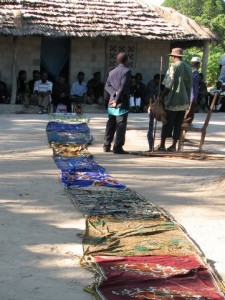
At a ceremony to install a clan leader that took place a few months ago I observed a new twist that I had never seen before. When the clan leader arrives for the ceremony he is accompanied by a crowd that sings and dances along a path to the front porch of the house where the main part of the ceremony will take place. In this particular ceremony the twist was that the ladies attending the ceremony all lent their outermost skirts to be used to make what would be the local version of a “red carpet.” The clan leader was led along this path on as he was being accompanied to the house. This provided a good example to use in explaining the purpose of the branches and coats laid on the road in front of Jesus during his triumphal entry into Jerusalem.