Dozens of deadly bamboo spears, as sharp as razors, were mounted in the dirt on both banks, pointing at us as we came up the river in our dugout canoe. Short totem poles lined the river behind the spears. Each head-and-shoulder figure had a weapon; a wooden rifle or a spear. Some had tin plates as helmets. The vine rope across the river had been removed and we were now permitted to return to the village. We had lived in the village for two years. Still, the sense of foreboding remained. Should we proceed?
The feeling reminded me of the day we moved in to live among the Da’an headhunters. I was seventeen. We had passed these same barriers, oblivious to the armed wooden presence on the river banks. The jungle brush had hidden them. My father, younger brother and I had been here before to survey and transport the household things we needed. My mother and sister were meeting the Da’an people for the first time.
The village chief led us to the house where we would live. Pigs and chickens scampered under the building as we climbed the notched log six feet to the deck. The deck was made of split bamboo tied with rattan across ironwood joists. The building was a “longhouse” built on large ironwood stilts, rising to a roof made with ironwood shingles. Along the length of the building, half was a long porch. The other half was a row of simple rooms. Our room would be the middle of five.
Of the old tree-top high longhouse, which had been hundreds of feet in length, only one apartment remained in the village as an example. The old longhouse had been burned down. Nearly everyone had lost their possessions. We were told that our neighbor was the man who chased the “lazy fool” who had burned the village. Our neighbor had brought final revenge. A thin wall of tree bark separated our dwelling from his.
We moved our belongings inside. It was dark in there. Smoke black. The kitchen was a sandbox in the corner with three stones which could support a pot. Smoked kindling lay over the fire box. We would live here until we were able to build our own house. … about a year later.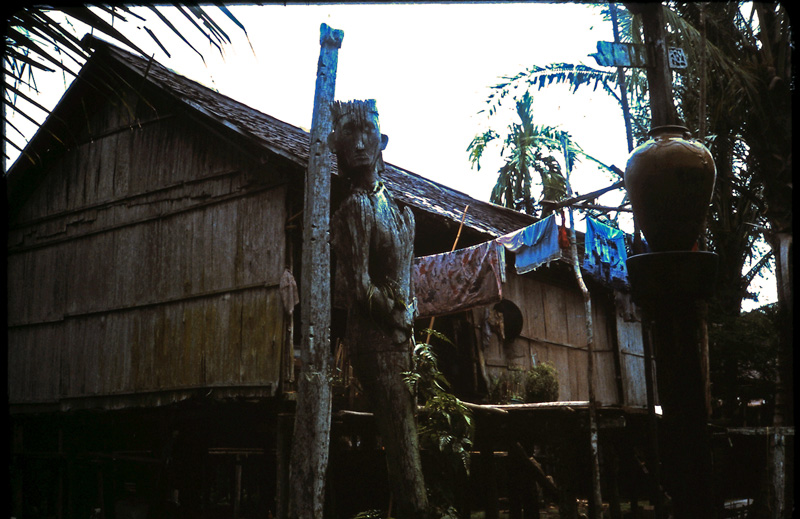
A growing stream of visitors came to talk, gawk and inquire. People packed the porch in front of our dwelling.
Children stared at us with wide eyes. They had been told we might eat them.
As darkness fell, a rhythm, beat out on a row of brass gongs, prompted feet to move in slow martial arts dances with swinging machetes. Tunics made of colored beads adorned some of the dancers. As they waved their fancy long knives human hair dangled from the bone handle.
Villagers drank from glasses filled from vats full of rice wine. Everyone was asked to drink or at least touch the glass to appease the ancestral spirits. Some also drank from glass bottles marked 100 proof.
Voices of people speaking in a language we did not understand rose and fell all through the night. Loud gongs three feet in diameter punctuated the music into the early morning. Though exhausted from two long days of river travel, we did not sleep much that night.
That was the village where I learned to personally apply a previously memorized verse.
Psalm 23:4 “Yea, though I walk through the valley of the shadow of death, I will fear no evil: for thou art with me; thy rod and thy staff they comfort me.”
At times, it was a slow, deliberate choice to trust God. He brought us there. He would guide, provide and protect until He had something better for us.
How would we bring the Gospel to these people? Did they have any knowledge of the Creator God? To whom did they feel accountable? Did they have a concept of sin? What would it take to accomplish our objective?
Two years later, as we watched the Da’an people feed rice offerings to their wooden army guarding the river, we had learned enough to grasp some of the answers. They tied a large rattan vine all the way across the river to warn travelers: Do Not Pass. They cut back the jungle overgrowth, refreshed the armaments of their wooden army and placed food offerings on them while speaking special incantations.
In the village, they offered animal sacrifices of chickens or pigs to appease the spirits and collected the blood. They waved special fronds dipped in the blood around the inside of the houses to chase out the evil spirits. They nailed a stick figure of a person to the door post, applied blood and, next to it, mounted a small basket of food.
Working their way systematically through the village, they arrived at the river. They built a raft on which they placed offerings of cooked samples of secret rices and included their normal white rice, red rice, black rice and yellow rice. They sprinkled it all with blood. They bit down on a special bush knife (machete) with their teeth while washing in the river. Touching the knife to raft, they sent the raft floating down the river in hope that the spirits of death and sickness would follow it to that place from whence they believed it all came. The wooden army below the village was to repel the illness and evil spirits from returning.
Their beliefs held them firmly in constant drunkenness, immorality and conflict. Rituals required constant hard work for gathering food, making decorations and performing ceremonies to appease the spirits of the dead in an attempt to keep the living alive.
Only the work of God’s Holy Spirit through the presentation of God’s written Word could bring transforming truth into the lives of the Da’an people. A team of people would be necessary to bring truth to them.
For the Da’an people to understand the identity and character of the God who created them, some on the team of Christians would translate key portions of the Bible. Some would also teach. Some would buy food, pack boxes and ship supplies. Some would fly aircraft. Some would handle the accounting. Some would send support in gifts and logistical assistance. All on the team of Christians would pray.
Reaching the Da’an people required a team of Christians to send and support messengers to communicate the message of God’s grace.
We were part of that team. Living among the Da’an people to learn their language and worldview were necessary to effectively communicate the truths of God’s Word to them. Traveling the rivers for fuel, supplies and medicine, we crossed their spirit barriers and prayed.
The Gospel was presented at great cost. Discipleship cost more. Supporters in many churches persevered in gifts and prayer.
The goal is the spiritual maturity of the Da’an church. Equipping Da’an people to do the work of the ministry was the objective. They, too, could represent Christ as His ambassadors to the people around them.
Working among the Da’an, common jungle illnesses plagued all of the missionaries and their families at one time or another. Malaria, filariasis, hepatitis, dengue fever, scarlet fever and the frequent infections of jungle living were common.
Among the missionary families to serve the Da’an people, one young family departed after much struggle from the stresses. A missionary wife nearly died there and was unable to return. A husband had a tree fall on him breaking his back. Another wife battled cancer, persevering in ministry after recovery until her husband died of a brain tumor. Only last year another missionary husband died of a massive heart attack at age 36. He was working on translating the Da’an Bible. The remaining missionary husband has been diagnosed with an aortic aneurism.
Was it and is it worth it?
The better question is this: Is Jesus worth it?
The answer is YES! Jesus is worth what it costs to proclaim His glory in the most remote places on earth!
Today there are churches of Bible-believing Christians among the Da’an people. There will be people of the Da’an language singing praises around the throne of our Savior when we get there. The testimony of God’s grace in the Da’an church continues.
Still the Da’an church does not have a completed New Testament in their language. Will you pray for them?
Here is a translation of a letter the Da’an church has written asking for prayer. >>Click here. <<
There are many more people groups like the Da’an who are waiting for someone to bring the Way, the Truth and the Life to them. They are waiting for a team of Christians who will invest in their eternal future. Some have been asking for years for missionaries to come tell them about God in their own language. Each will require an investment measured in years. Perhaps this is why they are listed among “the least reached.” There are not yet enough Christians who have caught the vision to meet the requests. Team members are needed!
Diana and I are working to build the team. Just as we were taught God’s word and shown the opportunities to get involved with reaching “least reached peoples” with the Gospel, we now have the opportunity to help others get involved.
New Tribes Mission has effective training in place to equip the messengers. People with many different kinds of skills are needed as part of the team. Senders and people who will pray are also greatly needed.
While trusting God to accomplish His purposes, the works side of a living faith requires that we speak His word to people who will listen, that we tell about the people whom He loves who live in remote places on earth, that we show churches how they can get involved and that we present the opportunity to serve to the messengers who will carry life to the spiritually dead.
Will you help us as part of the team sending God’s word to people groups who do not know His name?
Jesus is worth it!
Thank you for praying and working with us!
Randy & Diana Smyth
(>>Similar gongs<< )