The Agutaynen language often will use vagueness. For example, often an Agutaynen will come to us in the village and ask, “My um is in need of some um. Could you please give us some um?” If this happened to you, would you give them some um? We assume you wouldn’t until you found out what um is. First of all, the Agutaynen is very vague to “save face”. If you say “no” right away, then you haven’t offended the Agutaynen. But in order to find out the need, we need to ask the Agutaynen several questions.
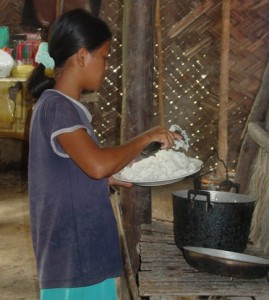
Usually, we start by asking them what is needed. The Agutaynen will then tell us, for example, the need is rice. We have now figured out one of the ums. Then we ask who needs rice to find out the other um. The Agutaynen shares that their family has no rice. So the second um is their family. So now we have deciphered all the ums and we know what the Agutaynen was saying: “My family is in need of some rice. Could you please give us some rice?”
Sometimes all this vagueness can become tiresome, but at other times we can use it too. For example, it would be very natural for us to use this um word whenever we forget or don’t know a word in Agutaynen and this would be natural for the Agutaynen hearer. However, we never want to use the um word when we are sharing the Gospel message with the Agutaynens. We don’t want to be vague but very clear when we share that salvation is by Jesus Christ alone.
Another good example is the New Testament translation in Agutaynen. What would you think if you read John 3:16 like this, “For um so loved the um, that he gave his only um, that whosoever ums in um, will not um, but have um um?” Hopefully you agree with us that the littlest words, even pronouns like “he”, are very important when proclaiming the Gospel message to the Agutaynens.
Lastly, we want to thank each of you for your um and um. In case you don’t speak Agutaynen, we want to thank each of you for your encouragement and prayer.